
SHRED A BILLION Co-op Guide: 4-Player Roles
How SHRED A BILLION four-player co-op works: shared progress, party pricing, voice chat, roles, and the setup that keeps a group moving.
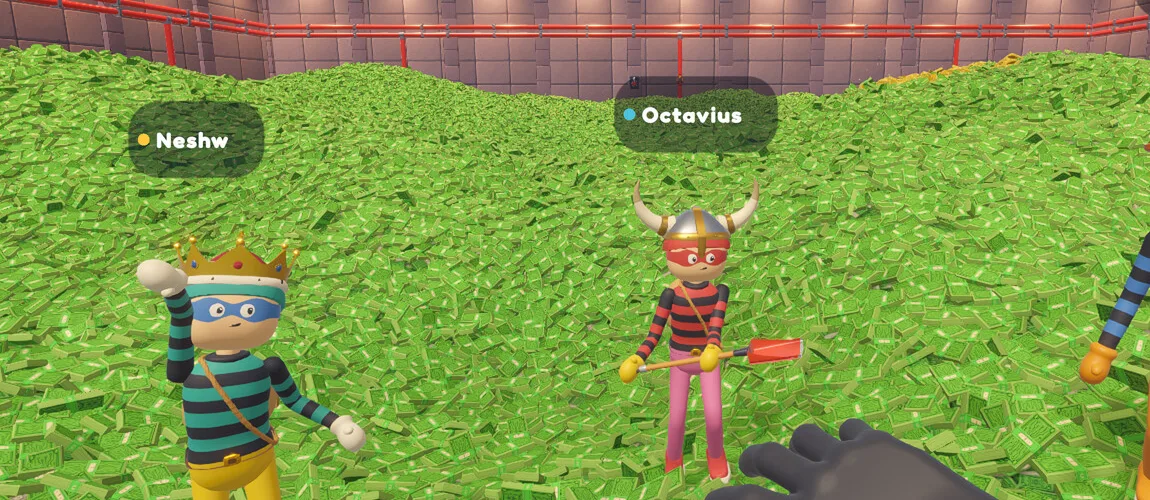
Co-op is the best way to play SHRED A BILLION and the fastest way to ruin a first run. The game shares everything: the vault, the wallet, the upgrades, and the counter. That generosity is wonderful with the right group and frustrating with the wrong one.
This guide covers how the session works, how the pricing changes, and the role split that keeps four players from standing in the same doorway.
Three companion guides cover the decisions around this one: the SHRED A BILLION Beginner Guide: First Hour Route→, the SHRED A BILLION Upgrade Priority: What to Buy First→, and the SHRED A BILLION Vault Floors: 1-5 Walkthrough→.
How co-op works
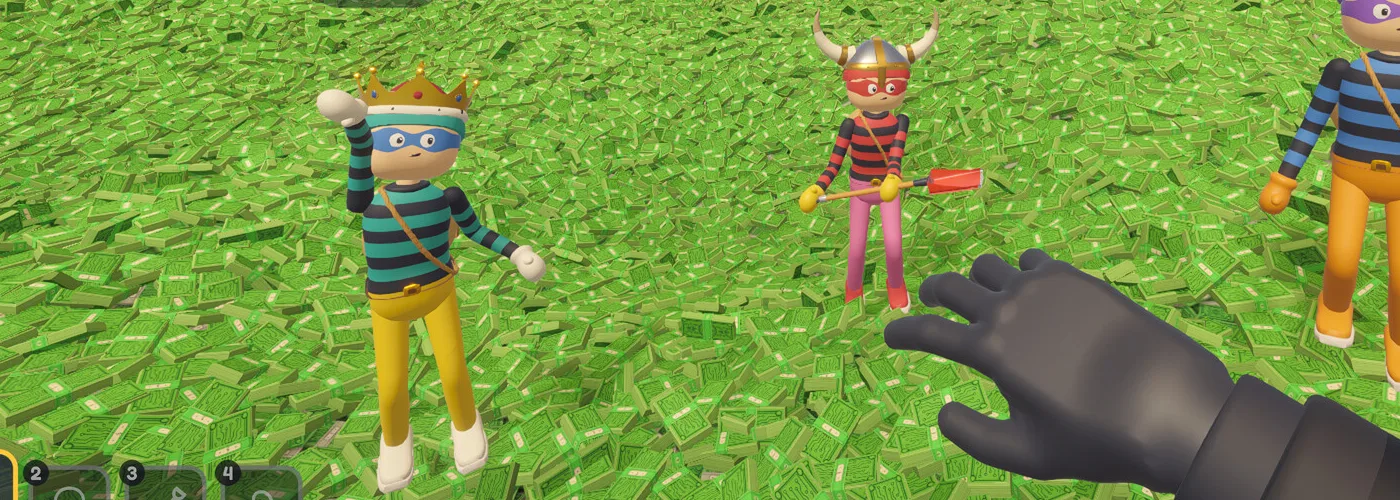
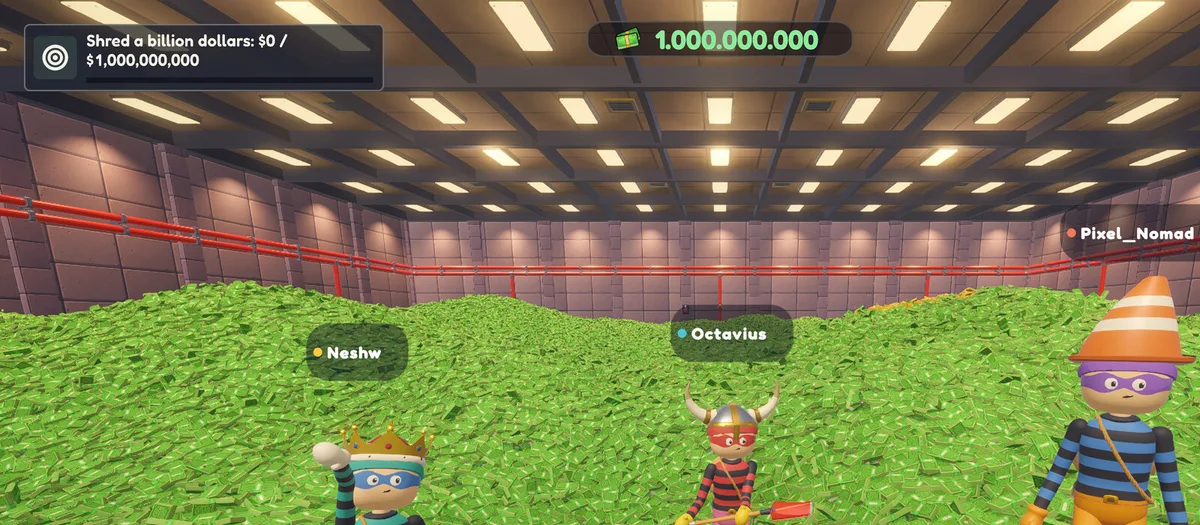
Up to four players join online. There is no split-screen and no local co-op. The host's save is the shared save, and everyone plays in the host's vault.
Voice chat is built in. Text chat is also available. The game supports full controller play, so a mixed group of keyboard and gamepad players is fine.
Progress is shared in the literal sense: when one player shreds a bill, the counter drops for everyone. When one player buys an upgrade, the whole group gets it. There is no per-player wallet and no loot assignment.
That means the group is a single economic unit. The fun comes from dividing the work, not from competing for the money.
Party pricing, explained
The upgrade board shows a multiplier when you are in a group. Solo prices are lower; group prices scale with the number of players. The intent is to keep the run length roughly similar whether you play alone or with three friends.
The practical effects:
- A four-player group pays more per upgrade than a solo player.
- The group's total income is higher because four players clear faster.
- The ratio is tuned so the run does not become trivial.
Do not treat the higher price as a penalty. Treat it as the cost of coverage. Four players can clear four rooms at once, which is worth more than the discount they give up.
The role split that works
The vault rewards parallel work. A group that all vacuums the same pile is slower than a solo player. A group that splits by job is much faster.
Here is a four-player split that works on every floor:
The hauler. Takes the vacuum, clears the densest pile, and feeds the shredder. This player is the group's income engine and should get the first capacity upgrades.
The opener. Takes the shovel and the jetpack, finds the route down, and breaks the packed walls. This player is always one room ahead, which means the group never waits for a path.
The collector. Takes the bucket and sweeps the edges, balconies, and corners the hauler skips. This player finds the golden banknotes, the relics, and the hats, and calls them out.
The runner. Handles the shredder, buys the shared upgrades, and keeps the group informed. This is the closest thing to a leader, and it is the role that prevents the classic "who bought that?" argument.
Rotate roles between floors if someone is bored. The split is a default, not a class lock.
Let one player hold the wallet and make purchase calls. Four players buying at once is how a group wastes a full floor's income on duplicate categories.
Communication that actually helps
The game has voice chat, but a group still needs a small vocabulary:
- "Counter" — read the remaining total. It tells the group how close the key is.
- "Pile" — a dense pile that needs the hauler.
- "Route" — a new path down.
- "Gold" — a golden banknote or a high-value object.
- "Buy" — a purchase the runner is about to make.
Keep it short. The vault is loud, the shredder is louder, and long explanations get lost.
If you are playing with strangers, use text chat for the plan and voice for the moment-to-moment calls. Do not assume everyone has a microphone.
Hosting and joining
The host owns the save and the progress. If you want your own completion, host your own session. Joining a friend's game is joining their vault, not merging two saves.
Before you invite anyone, decide:
- Is this a fresh run or a continuation?
- Who is buying upgrades?
- Are we clearing every floor or rushing the door?
- Are we using voice or text?
A group that answers those four questions before the first shred avoids most of the friction.
Co-op and the golden key
The key is shared. One player can pick it up, and the door opens for everyone. The cutscene plays for the group, and the host's save records the completion.
Wait for the whole group before opening the door. The ending is short, and missing it because you were on the wrong floor is a bad way to finish a three-hour run.
If a player is disconnected when the key is picked up, they can rejoin before the door sequence. After the door, the session is effectively over.
What co-op does not fix
The first hour is still slow. Four players with hands are four times the walking, not four times the fun. If the group is new, play the demo together first.
The upgrade board is still shared. One player's bad purchase is everyone's bad purchase. That is why the buyer role matters.
The leaderboard is separate. Solo and co-op clears have separate boards. A four-player time is not comparable to a solo time.
Achievements may not be shared the way you expect. Assume they follow the host's save and check the list after the session. If you care about completion, do a solo cleanup pass later.
A sample first session
- Host starts a fresh save and invites three players.
- Everyone clears floor 1 by hand for ten minutes to learn the loop.
- The runner buys the bucket and the first capacity levels.
- The opener takes the shovel route; the hauler takes the dense piles.
- The group descends together until the vacuum, then splits by floor.
- The runner buys drones when the shredder stops queuing.
- The group regroups at the bottom for the key.
That is a three-hour session with breaks. It is also the best way to see the game's systems interact, because four players hit the bottlenecks at different times.
The short version
Co-op shares everything, prices upgrades for the party size, and rewards role splits. Pick a buyer, give each player a job, and regroup for the key. The vault is the same size either way; the difference is how many corners you can clear at once.
The facts on this page are checked against the Steam store page ↗, the launch announcement feed ↗, and the official Discord ↗.
Related
- SHRED A BILLION Beginner Guide: First Hour Route→
- SHRED A BILLION Upgrade Priority: What to Buy First→
- SHRED A BILLION Vault Floors: 1-5 Walkthrough→
FAQ
How many players can play co-op?
Four, online. There is no split-screen or local co-op.
Is progress shared in co-op?
Yes. The wallet, upgrades, and vault total are shared. The host's save is the group's save.
Sources
Official source: SHRED A BILLION on Steam ↗ and the developer's patch notes in the official Discord.