
SHRED A BILLION Money Guide: Bills, Bundles, Income
How money works in SHRED A BILLION: bill values, bundles, payout multipliers, cash drops, and how to read your real income in the stats panel.
SHRED A BILLION has two currencies and only one of them is money. The other is bills moved, and the difference explains most of the weird swings in your income.
This guide breaks down what a bill is worth, why your wallet jumps in chunks, and how to tell whether an upgrade actually made you richer or just made the numbers bigger.
Three companion guides cover the decisions around this one: the SHRED A BILLION Upgrade Priority: What to Buy First→, the SHRED A BILLION Drone Guide: Automation and Idle Curve→, and the SHRED A BILLION Vault Floors: 1-5 Walkthrough→.
Bills, bundles, and the counter
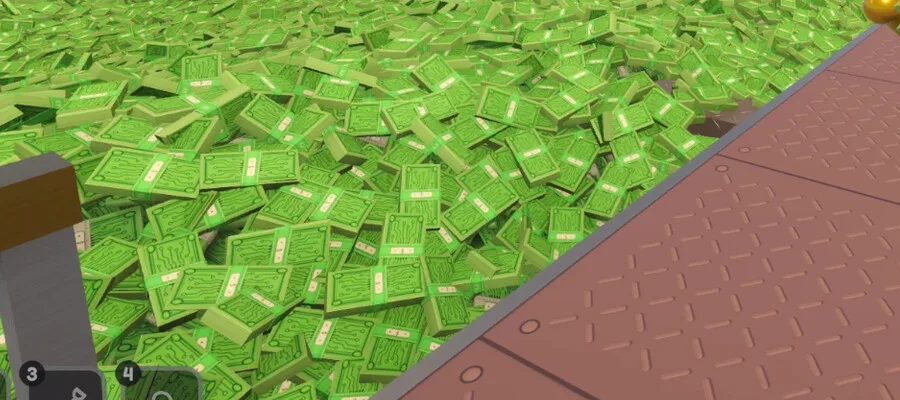
The vault contains one billion dollars in bills. The counter at the top tracks the remaining value, not the number of physical objects. A bill on floor 5 is worth more than a bill on floor 1, which is why the same amount of vacuuming produces very different payouts at different depths.
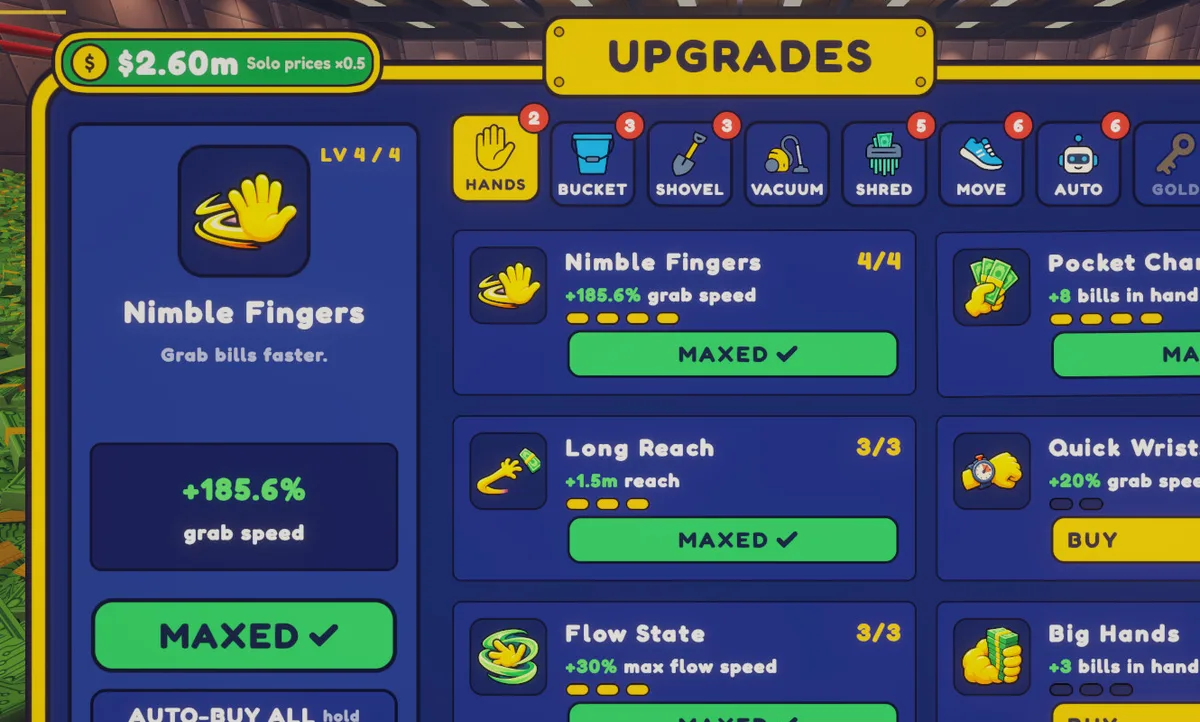
Bundles are the physical stacks you pick up. A bundle contains multiple bills, and upgrades that add "bundles per grab" or "bills in hand" change how much value you can move per interaction. The distinction matters because:
- Bills in hand is a capacity stat. It decides how much value fits in one trip.
- Bundles per grab is an interaction stat. It decides how much you pick up per click or scoop.
- Payout is a conversion stat. It decides what the shredder pays per bill.
A run can be rich in one and poor in another. The stats panel is how you tell.
Reading the stats panel
Press I to open stats. The panel tracks the numbers the HUD does not show: lifetime earnings, current income rate, bundles processed, and proficiency progress. The exact layout is build-specific, but the useful entries are consistent:
- Income per second is the number to watch when you are idling or running drones.
- Lifetime earnings is the number that unlocks achievements. It does not go down when you spend.
- Bundles shredded is a separate counter from money and is used by several achievements.
If you are comparing two upgrades, buy one, check the income rate, and reload the save if it was worse. The game saves at any time, so this is a cheap experiment. It is also the only honest way to compare percentage upgrades, because the board does not show the resulting rate.
Why your wallet jumps in chunks
A full load fed to the shredder pays out all at once. That creates a sawtooth income graph: flat while you walk, spike when you feed. The average is what matters, and the average is why capacity often beats speed.
A player with double capacity takes half as many trips. Even if their grab speed is lower, their income per minute is higher because the walking share drops. This is the single most important economic idea in the game, and it is why the upgrade priority guide puts capacity first.
The same logic applies to the vacuum. A wide vacuum that fills a load in one pass is worth more than a fast vacuum that requires three passes, because the passes are trips in miniature.
Cash drops and golden banknotes
Golden banknotes are the game's burst income. The prize machine tracks them, and the displayed prize at launch is a Cash Drop: two minutes of income, paid at once. That is a real multiplier on your current rate, not a fixed amount, which means it is worth more the later you claim it.
Two implications:
- Do not rush the prize machine early. A two-minute cash drop at floor 1 income is small. At floor 4 income it can fund a drone.
- Raise your income before cashing in. If you are close to a prize, buy the income upgrade first, then claim.
Golden banknotes themselves are collectibles, not currency. You do not spend them; you feed them to the machine and it pays out on a counter. The machine shows the progress to the next prize.
If the prize is a two-minute payout, the best time to claim is immediately after a big income upgrade, not before it.
Multipliers and critical shreds
Some upgrades and relics add multipliers: critical shred chance, lucky bundles, bundle value, and gold perks. These are spike stats. They raise your best-case income without raising your floor.
Spikes are good for:
- Burst achievements.
- Screenshots.
- The feeling of a lucky run.
Spikes are bad for:
- Planning a purchase.
- Comparing two upgrades.
- Co-op, where the group's income is averaged across four players.
If you have to choose between a reliable 10% and a 25% chance of a spike, take the reliable number unless you are chasing a specific achievement.
Money in co-op
Co-op shares the wallet and the vault. That means:
- One player's purchase benefits everyone.
- The upgrade prices scale with party size, so the group pays more per level than a solo player.
- The host's save is the shared save.
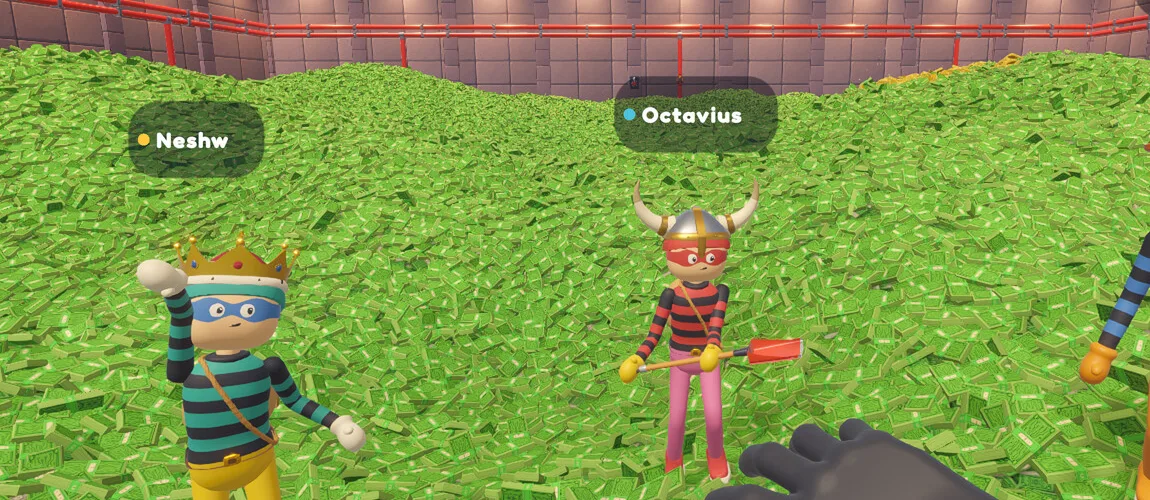
The economic consequence is that co-op is not four times faster. The party-size pricing is designed to keep the run length similar whether you play alone or with three friends. The benefit of co-op is coverage, not free money: four players can clear four corners at once, which reduces walking even if the total payout per bill is unchanged.
If your group wants to optimize, designate a buyer. One player holds the wallet and buys the shared upgrades while the others clear. This avoids the classic argument where two players buy the same category at once and waste the second purchase.
What money cannot buy
Money cannot:
- Open the vault door. The key requires clearing, not saving.
- Skip the golden key spawn.
- Buy achievements directly, although some are money milestones.
- Replace proficiency points. The tree uses levels, not cash.
That is a healthy design. The wallet accelerates the vault, but it does not bypass it. The last stretch is always a physical clear, and the players who understand that spend their money on tools rather than on hoarding.
A practical income routine
- Fill your largest-capacity tool at the densest pile.
- Feed the shredder in one go.
- Buy the cheapest trip-removing upgrade.
- Check income per second in the stats panel.
- Repeat until the next tool unlock, then re-test.
That loop is the game. The numbers get bigger, the floors get deeper, and the shape stays the same. Once you can see the shape, the upgrade board stops being a wall of prices and becomes a list of ways to shorten your next walk.
The facts on this page are checked against the Steam store page ↗, the launch announcement feed ↗, and the official Discord ↗.
Related
- SHRED A BILLION Upgrade Priority: What to Buy First→
- SHRED A BILLION Drone Guide: Automation and Idle Curve→
- SHRED A BILLION Shredder Upgrades Explained→
FAQ
What is a cash drop worth?
Two minutes of your current income, paid at once. It scales with your rate, so claim it after a big income upgrade.
Why does my income jump in chunks?
Because the shredder pays per load. Average income per minute is what matters, not the spike when you feed.
Sources
Official source: SHRED A BILLION on Steam ↗ and the developer's patch notes in the official Discord.