
SHRED A BILLION Upgrade Tier List by Category
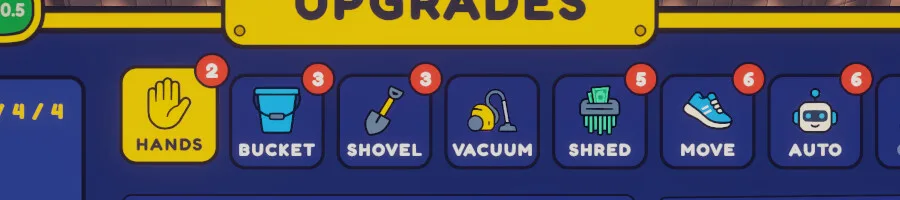
A category-by-category SHRED A BILLION tier list: which upgrade lines carry a run, which are support, and which are traps for new players.
A tier list for this game cannot rank individual upgrades the way a character tier list ranks fighters. The board is contextual: a hand capacity level is S-tier in the first ten minutes and F-tier after the vacuum. What can be ranked is the category, because each category has a job that stays relevant or falls off.
This list assumes a normal solo run toward the vault door. Co-op shifts a few entries, and the notes call those out.
Three companion guides cover the decisions around this one: the SHRED A BILLION Upgrade Priority: What to Buy First→, the SHRED A BILLION Shredder Upgrades Explained→, and the SHRED A BILLION Vault Floors: 1-5 Walkthrough→.
How the tiers work
- S — carries the run; buy every level you can afford without blocking a tool unlock.
- A — strong support; buy when the S-tier line is priced out.
- B — situational; worth a few levels, not a priority.
- C — cleanup; buy after the vault is clear or for achievements.
S-tier categories
Carry capacity (hands, bucket, vacuum)
The single most valuable stat in the game. Every capacity level removes trips, and trips are where the time goes. The hand version matters only early, but the bucket and vacuum versions stay relevant through the descent.
In co-op, capacity is even better because a full load benefits the whole party's pace. If you are the designated hauler, this is your line.
Vacuum intake width
The vacuum is the tool that turns a room into a stream. Width determines how much of a pile you can address without repositioning. A wide vacuum with a modest suction rate clears faster than a narrow vacuum with a high rate, because you spend less time aiming.
Drone count (automation)
Drones are the only upgrades that earn while you are not holding a tool. The first few are transformative; the last few are luxury. S-tier does not mean "rush all sixteen", it means "this is the line that changes the game's genre".
A-tier categories
Reach
Reach removes a step, not a trip. That is still excellent, especially around the shredder where the intake has a specific spot. One or two levels in each tool is enough; stacking reach past the pile size is wasted.
Shredder throughput
The shredder is the conversion valve. If your loads are full and your wallet is empty, this is the best purchase on the board. It drops to A because it does nothing for routing, and there are moments when a tool unlock matters more.
Shovel power
The shovel's job is opening packed piles and routes. Its combat-style stats are less important than whether it can break the next layer. Buy enough to keep descending, then stop.
Drone capacity
A drone with a bigger load makes every trip count. It is A-tier rather than S because the first drone count matters more than the size of each delivery; a swarm of small drones saturates a room faster than two big ones.
B-tier categories
Grab speed
Pure time-inside-a-trip. It feels great and it is never bad, but it does not remove a walk. Buy it when capacity and reach are priced out.
Movement speed
The vault is compact and the jetpack covers vertical gaps. Movement speed is a comfort upgrade. It becomes better in co-op if you are the runner between floors.
Critical chance and lucky bundles
These add spikes to income. Spikes are fun and they help with burst achievements, but they do not raise your floor. A run that depends on crits is a run that feels inconsistent.
Bucket capacity after the vacuum
The bucket remains useful for small cleanups and for the "feed one by hand" style achievements, but the vacuum eats its job. Stop investing once the vacuum is online.
C-tier categories
Golden banknote effect nodes
These modify a collectible that appears on a timer. They are a nice bonus and a poor primary plan. Buy them after the vault is clear, when their percentage applies to a much larger income.
Cosmetics and hat-related nodes
Hats are fun and some relics are cosmetic. If a node only changes appearance, it is a completion purchase, not a progression one.
Economy nodes that only affect selling or conversion rates
If the node does not change how much you carry or how fast you clear, it is a multiplier on a number you have already solved. Multipliers are good when the base is large, which means late.
The trap tiers
Two categories look better than they are:
Hand speed after the bucket. The hand is a tutorial tool. Maxing it is a completion goal, not a strategy. New players do this because it is the first visible category and the levels are cheap.
Shredder speed before the vacuum. A fast shredder cannot compensate for a slow intake. If you are feeding it by hand, the bottleneck is your hands, not the machine.
An S-tier category with a price you cannot afford is worse than an A-tier level you can buy now. Always compare the next level's cost against the next tool unlock, not against an abstract ranking.
Co-op adjustments
| Category | Solo tier | Co-op tier | Reason |
|---|---|---|---|
| Carry capacity | S | S+ | Shared pace improves for everyone |
| Drone count | S | S | Frees players for routing |
| Movement speed | B | A | Runners cover more ground |
| Personal hand speed | B | C | Does not stack across players |
| Shredder | A | S | One shared bottleneck for the group |
The co-op column assumes a coordinated group. A random lobby that all buys personal speed will feel worse than solo, because the prices are higher and the purchases do not combine.
What the tier list misses
It cannot rank timing. The best upgrade in the game is the one that arrives one trip before it stops mattering. A capacity level bought when you are already carrying full loads is worth more than the same level bought at the start of a floor, because the piles are bigger.
It also cannot rank fun. Critical hits and golden banknotes are the most enjoyable parts of the game for many players, and a tier list that tells you to skip them is giving advice for a stopwatch, not for a person. If you are not chasing the leaderboard, buy the fun thing.
The one-sentence version
Buy capacity and reach until trips are short, buy the next tool before maxing the old one, buy the shredder when your wallet is the bottleneck, and buy drones before you buy another hand level. Everything else is style.
The facts on this page are checked against the Steam store page ↗, the launch announcement feed ↗, and the official Discord ↗.
Related
- SHRED A BILLION Upgrade Priority: What to Buy First→
- SHRED A BILLION Shredder Upgrades Explained→
- SHRED A BILLION Money Guide: Bills, Bundles, Income→
FAQ
Which upgrade category is best?
Vacuum capacity and drone count are the strongest long-term categories. Shredder payout is strong only once throughput is solved.
Are gold upgrades worth it?
Usually yes, because they are multipliers rather than flat additions. Buy them when you can afford them without delaying a tool unlock.
Sources
Official source: SHRED A BILLION on Steam ↗ and the developer's patch notes in the official Discord.